Why Robots.txt Still Matters for AI Search Discovery
Use a clean robots.txt file to control crawler access clearly while keeping expectations realistic about indexing, snippets, and AI search visibility.
Open Robots.txt Generator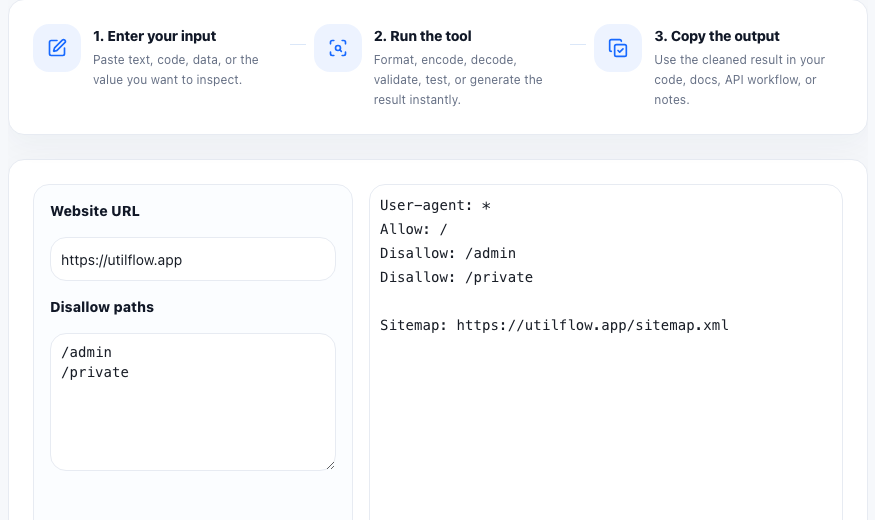
Robots.txt is getting renewed attention because publishers now think about both classic search crawlers and AI-related crawlers when they decide what should be fetched. The file still matters, but mostly as crawl control and crawler communication rather than as a magic visibility switch.
What the current guidance actually says
As of June 2026, Google Search Central still documents robots.txt as a way to control crawling and explicitly warns that blocking crawl access is not the same thing as removing a URL from search results. OpenAI's ChatGPT Search help and crawler guidance also describe OAI-SearchBot access as a prerequisite for inclusion and note that host or CDN protections may need to allow that traffic as well.
What a practical robots.txt file should do
- State the crawler rules clearly instead of relying on accidental defaults.
- Block paths that should not be crawled because they waste crawl budget or expose low-value internal routes.
- Include the sitemap URL so compliant crawlers can find the canonical page list faster.
- Avoid using robots.txt as the only mechanism for noindex-style goals when indexing control is the real requirement.
Why this matters in GEO and AI-search discussions
A lot of GEO advice collapses three different questions into one: can a crawler fetch the page, can a search engine index it, and can a system choose to cite it. Robots.txt mainly answers the first question. It is still part of visibility hygiene, but it does not replace page quality, indexability, canonical signals, or snippet controls.
A conservative workflow for site owners
Generate a readable robots.txt file, review the disallowed paths, add the correct sitemap location, and then verify the behavior with the search platforms that matter to you. If an AI crawler still cannot reach the site, check firewall, CDN, or bot-mitigation rules rather than editing the file blindly.
FAQ
Does robots.txt remove a page from search results?
Not by itself. It controls crawling access, but a blocked URL may still be known to a search engine unless indexing controls are handled separately.
Why would an allowed crawler still fail to reach my site?
The robots.txt rule may be fine while the host, CDN, firewall, or bot-protection layer is still blocking the crawler.
Should I include a sitemap line in robots.txt?
Usually yes. It gives compliant crawlers a clear path to your sitemap and makes the file more useful as a crawl-control document.