Why Meta Tags Still Matter for Search and Share Previews
Metadata is no longer a guaranteed display command, but it still helps shape cleaner previews across search and sharing surfaces.
Open Meta Tag Generator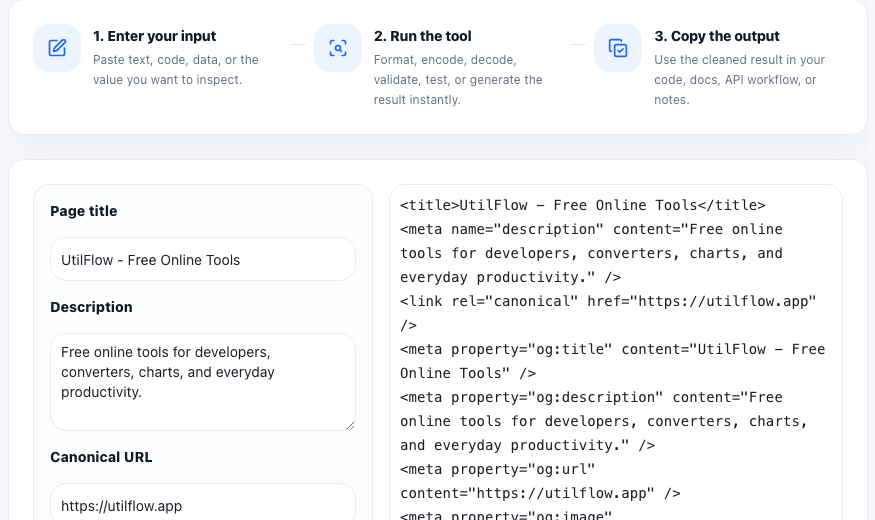
Metadata can feel old compared with AI-search discussions, richer result formats, and app-level link previews, but the underlying job is still current: give platforms a clean candidate title, summary, canonical URL, and preview image before your page gets reshaped elsewhere.
Why this still matters in 2026
Current Google Search guidance still maintains dedicated documentation for title links, snippets, and page metadata, even while its documentation also now includes generative-AI search guidance. That is a strong signal that metadata basics remain part of the publishing stack instead of becoming obsolete.
What current platform guidance actually suggests
Google explains that snippets are generated automatically from page content and may sometimes use the meta description when it provides a more accurate summary. Google also documents that title links can differ from the title element when page titles are weak, inconsistent, or repetitive. In other words, metadata is influence, not a hard display guarantee.
On the sharing side, the Open Graph protocol still defines core properties such as og:title, og:image, and og:url for representing a page as a rich object. That keeps Open Graph tags relevant whenever a link preview needs a stable title, image, and canonical destination.
The practical publishing workflow
- Write a title that matches the visible page intent instead of stuffing variants into the tag.
- Draft a meta description that summarizes the page clearly, knowing it may be used selectively rather than always shown.
- Set the canonical URL deliberately so shared and indexed versions point at one preferred address.
- Provide a real preview image and matching Open Graph fields so shared links have a stable visual payload.
- Keep the visible heading, metadata, and page body aligned so platforms have fewer reasons to rewrite your presentation.
What not to assume
Meta tags do not force every system to display your preferred title or description exactly as written. They also do not replace page quality, internal linking, crawl access, or structured content. Their value is consistency: they reduce ambiguity before different surfaces generate their own previews.
FAQ
Do meta tags still matter if Google can rewrite titles and snippets?
Yes. They still provide strong candidate signals and help keep search and share previews more consistent, even though the final display is not guaranteed.
What Open Graph fields matter most for shared links?
The core fields are og:title, og:image, and og:url, because they establish the basic title, preview image, and canonical page identity for the shared object.
What should I check after generating meta tags?
Check that the title matches the page intent, the description summarizes the real content, the canonical URL is correct, and the preview image is intentional and reachable.