What JSON to TypeScript Can and Cannot Infer From API Samples
Understand what a JSON-to-TypeScript generator gives you, where the inferred types are only a starting point, and what to review before shipping code.
Open JSON to TypeScript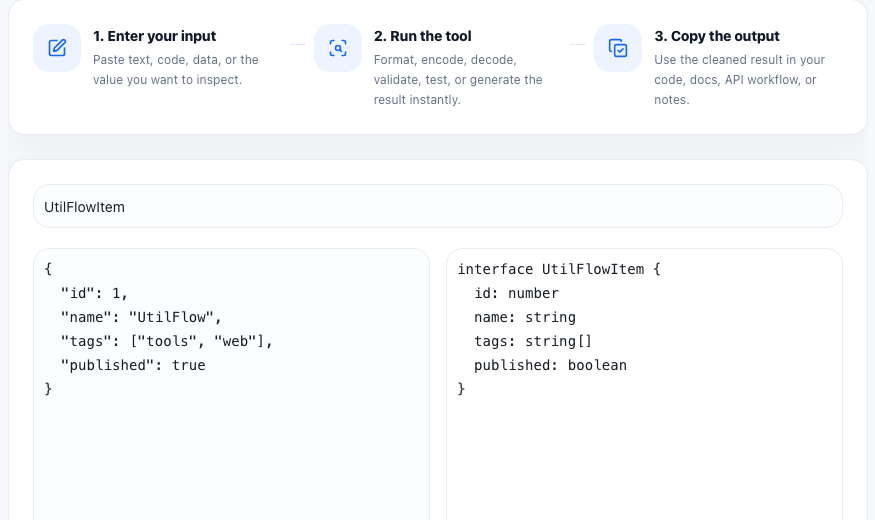
Generating TypeScript from JSON is a structural shortcut, not a contract validator. It reads the shape of the sample you paste and turns that observed shape into starter interfaces. That is useful when you need to move from a raw API example to typed code quickly, but it is only as complete as the sample in front of you.
What the generator can infer correctly
- Object nesting and property names.
- Primitive value shapes such as string, number, boolean, null, arrays, and nested objects.
- Repeated object structures inside arrays.
- A clean first-pass interface layout that is faster to review than typing everything by hand.
Where inference becomes weak
A single JSON sample usually cannot prove whether a field is always present, sometimes null, or absent in other responses. It also cannot reliably capture domain rules such as enum values, branded IDs, ISO date strings that should stay strings at runtime, or union types that only appear across multiple endpoint responses.
Why sample quality matters
If the pasted JSON comes from a partial log line, a mocked response, or one unusually complete user record, the generated interfaces inherit those biases. The safest sample is a realistic response that includes the optional branches, null cases, and nested lists you expect to handle in production.
A technical review workflow
- Generate starter interfaces from one realistic JSON sample.
- Rename overly generic interfaces so they match the domain language in your codebase.
- Review nullable and optional fields against the API documentation or several real responses.
- Replace broad inferred types with stricter unions or enums where your domain rules are known.
- Keep the generated output as a draft, then validate it with actual usage in the app or tests.
What this tool is best for
JSON to TypeScript is best when you need a typed starting point during API integration, debugging, documentation cleanup, or prototype work. It reduces clerical typing, but the final type quality still depends on human review and real endpoint behavior.
FAQ
Can JSON to TypeScript generate production-ready types automatically?
Sometimes it gets close, but it is safer to treat the output as a starter draft that still needs review for optional fields, unions, enums, and domain-specific rules.
Why are some generated fields too broad or too narrow?
The tool only sees the sample you paste. If the sample is incomplete or unusually specific, the inferred type reflects that limited evidence.
What should I check before copying generated interfaces into my app?
Check field optionality, null handling, naming, arrays, nested objects, and any business rules that are not visible from a single JSON example.