What a URL Parser Shows in a Long Tracking Link
Break a long URL into readable parts so you can inspect hosts, paths, hashes, and query parameters before debugging the wrong thing.
Open URL Parser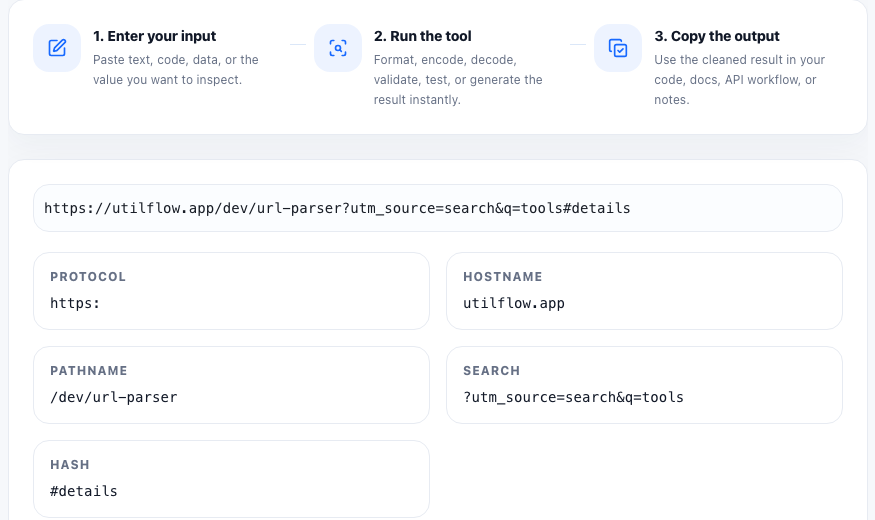
Long links are hard to debug because several concerns are packed into one string at the same time: destination, path structure, filters, tracking parameters, state, and sometimes a hash anchor. A URL parser turns that string back into named parts so you can see what is structural and what is optional.
What the parser separates
- Protocol, such as https, which affects transport and environment assumptions.
- Host and subdomain, which identify the destination system.
- Path segments, which usually map to route structure.
- Query parameters, which carry filters, tracking tags, IDs, or temporary state.
- Hash fragments, which usually control an in-page anchor rather than a new server request.
Why query parameters cause confusion
A long query string can contain repeated keys, encoded values, campaign tags, redirect targets, or JSON-like state. Looking at the raw URL makes it easy to miss whether a parameter belongs to navigation logic, analytics, or a copied user-specific token.
Encoded values and repeated keys
Percent-encoding hides spaces, symbols, and nested URLs behind escape sequences. Repeated keys can also matter because some systems read only the first value, some read the last value, and others treat them as arrays. Parsing the URL first makes those assumptions visible before you start changing the link.
Where this helps in practice
This is useful when debugging ad landing pages, redirect chains, support tickets with copied links, signed URLs, search pages with many filters, or onboarding flows where state is carried in the address bar.
FAQ
What is the difference between a query string and a hash?
A query string appears after a question mark and is typically sent to the server as part of the URL. A hash appears after a number sign and usually points to an in-page section or client-side state.
Why does a URL contain percent signs and numbers?
That is percent-encoding, which is how URLs represent spaces and reserved characters safely inside a link.
Can repeated query parameters be valid?
Yes. Many systems allow repeated keys, but they may interpret them differently, so it helps to inspect them explicitly.