Read degrees, radians, and turns correctly before a formula or canvas rotation drifts
Use an angle converter when design, math, and code workflows describe the same rotation in different units and a small mismatch keeps propagating.
Open Angle Converter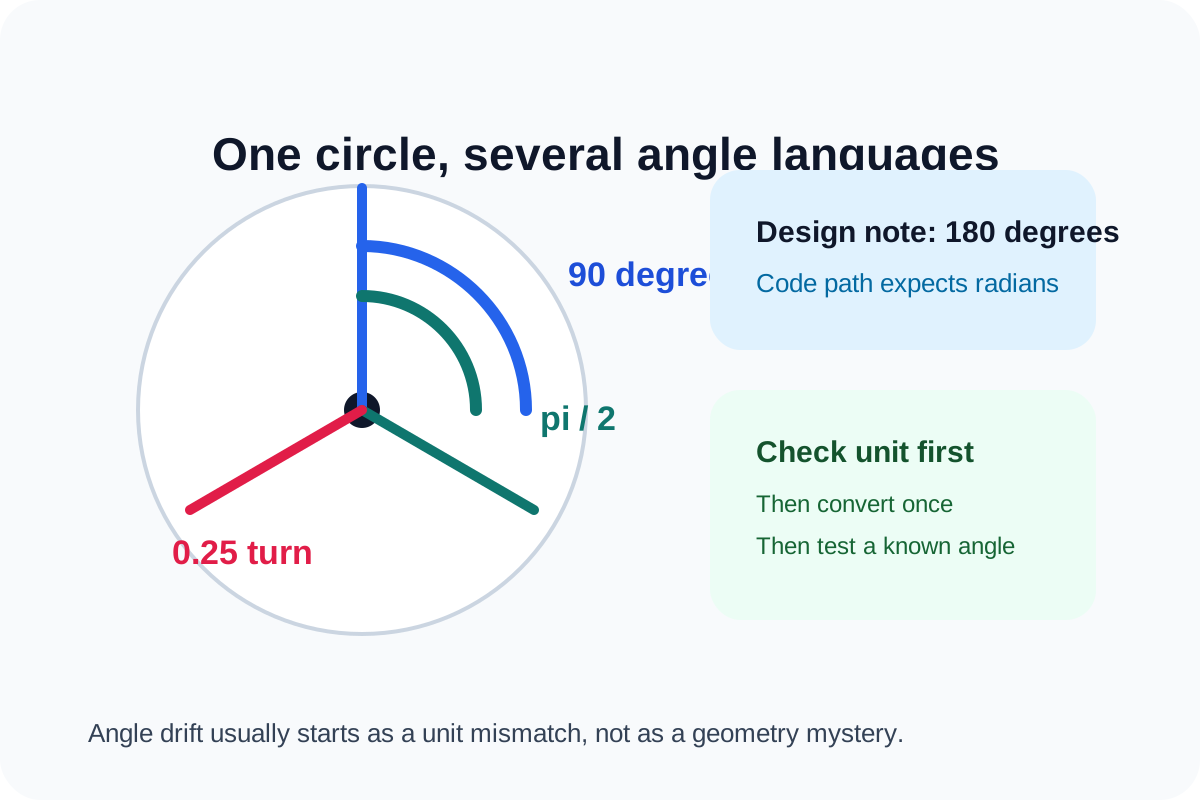
Angle bugs often look like layout bugs, geometry bugs, or animation bugs because the number itself seems close enough. The real mismatch is usually unit-level: a design note says 90 degrees, a formula expects radians, an animation tool accepts turns, or a plotting routine documents gradians. When the unit changes silently, every later rotation inherits the error.
What the units represent technically
- Degrees divide a full circle into 360 parts and are the most human-readable unit in design and everyday geometry.
- Radians describe angle as arc length relative to radius, which is why trigonometry, many libraries, and formula work often prefer them.
- Turns express rotation as a fraction of one full circle, which makes quarter-turn and half-turn thinking very direct.
- Gradians divide a full circle into 400 parts and show up in some surveying and educational contexts.
Where angle conversion breaks real work
- A CSS or canvas rotation is entered from a note written in a different unit.
- A trigonometry formula is copied from class notes, but the calculator or code path assumes radians.
- A chart, diagram, or CAD-style task compares values from systems that do not share the same angular language.
- A motion or game prototype rotates correctly once, then drifts because later edits mix units inconsistently.
A technical verification sequence
- Identify the unit used by the source note, formula, or UI control before converting anything.
- Convert the value into the exact unit expected by the destination system, not merely the unit you find easier to read.
- Test one simple known angle such as a quarter-turn so you can verify the rotation direction and magnitude quickly.
- Keep the converted value with its unit in the comment, ticket, or handoff note when someone else will reuse it later.
- If several angles belong to one calculation, normalize the entire set before debugging the geometry.
Related UtilFlow moves
If the same problem also mixes coordinate or scale values, use Length Converter or Aspect Ratio next so the geometry and the measurement labels become consistent together.
FAQ
Why do formulas often expect radians instead of degrees?
Because many trigonometric definitions and software APIs are built around radians as the natural mathematical unit for rotation.
When are turns easier to use than degrees?
Turns are easier when the task is expressed as fractions of a full circle, such as quarter-turn, half-turn, or one-and-a-half turns.
What is the fastest way to catch an angle-unit bug?
Convert a simple known value first, such as 90 degrees or one quarter-turn, and verify that the destination system produces the expected rotation.