What HTML Entity Encoding Prevents in Snippets, Forms, and CMS Fields
Understand the technical role of HTML entity encoding when angle brackets, quotes, and special characters should display safely instead of being interpreted as markup.
Open HTML Entity Encoder/Decoder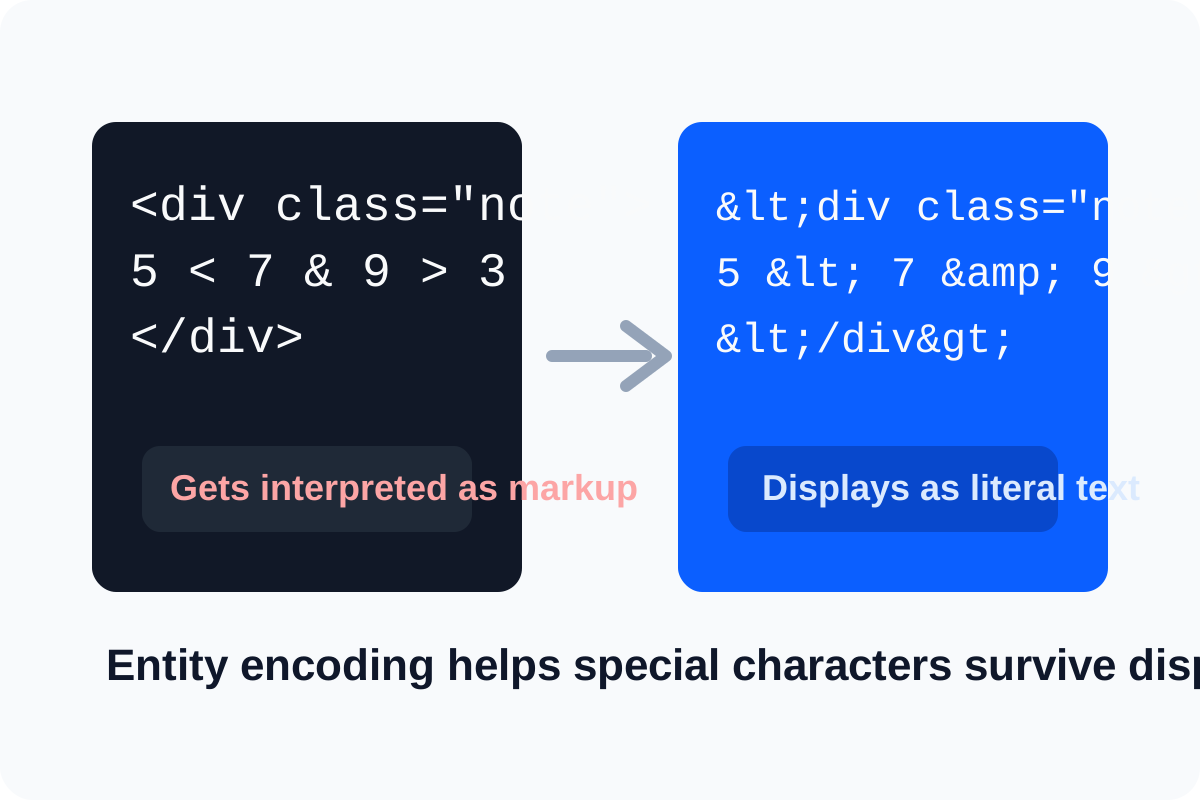
HTML entity encoding solves a narrow but important problem: sometimes a string should be displayed as text, not interpreted as markup. If copied examples contain angle brackets, ampersands, or quotes in the wrong place, a CMS field, help-center editor, internal doc, or code snippet block may render the content incorrectly or strip the part you actually wanted to show.
What encoding actually changes
- It converts characters like <, >, &, and quotes into their entity forms.
- It preserves the readable intent of a code example without letting the browser treat it like live markup.
- It reduces accidental rendering when copied snippets belong in documentation, training notes, or literal text fields.
- It helps separate content-display problems from broader sanitization or security policies.
What encoding does not do
Encoding is not a full security policy, and it is not the same as sanitizing arbitrary user input for every rendering context. Its technical role is smaller: make sure special characters are represented safely when the goal is literal display. That distinction matters because many bugs come from assuming one escaping step covers every HTML, attribute, script, and storage context automatically.
Where the mistake usually appears
- A documentation snippet disappears because the browser tries to render the example tags.
- A CMS field mangles copied markup that was only meant to be shown, not executed.
- A support article needs to display comparison operators, template braces, or tag-like placeholders literally.
- A training note mixes example code with live rich-text formatting and the result becomes ambiguous.
A practical technical check
If the destination should show the characters exactly as written, encode the special characters before pasting them into the field. Then preview the rendered result so you confirm the content is visible as text, not disappearing into formatting behavior.
FAQ
When should I encode HTML characters?
Encode them when the destination should display the markup-like characters literally rather than interpret them as real HTML.
Is entity encoding the same as sanitizing input?
No. Entity encoding is about representation for display, while sanitization is a broader policy question that depends on the rendering context and allowed content.
Why do angle brackets cause so many display issues?
Because browsers and rich-text systems often treat them as markup boundaries unless they are encoded first.